ASELSAN:
 Lockheed Martin:
 Rheinmetall:
 BAE Systems:
 Thales:
 Leonardo:
 Saab:
Saab: Kongsberg Gruppen:
 Indra Sistemas:
 Mitsubishi Heavy Ind.:
 Hanwha Aerospace:
 AVIC Shenyang Aircraft:
 Hindustan Aeronautics:


KEY INTELLIGENCE TAKEAWAYS & SUMMARY
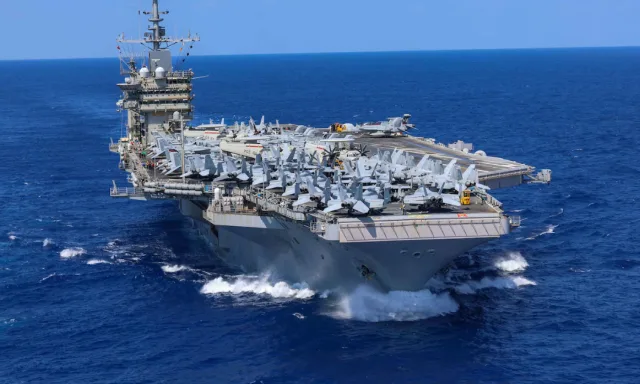
- USS Harry S. Truman (CVN 75), as the eighth member of the Nimitz class, is entering a critical RCOH process at its mid-life.
- Under the contract, the ship's two A4W nuclear reactors will be refueled and thousands of compartments will be modernized.
- While the total cost of the project reaches $5.18 billion with options, the work is planned to be completed by November 2031.
- This massive maintenance and modernization move will secure the operational capability of the US nuclear aircraft carrier fleet for the coming decades.
Activities to extend the operational life of nuclear-powered aircraft carriers, which are a critical threshold in global naval power balances, continue without slowing down. In this context, the US Navy has made a huge financial commitment for the mid-life modernization and nuclear refueling of the Nimitz-class nuclear aircraft carrier USS Harry S. Truman (CVN 75), one of the most important strike forces in its inventory. The massive contract signed with Huntington Ingalls Industries, one of the leading actors of the defense industry, kicked off one of the most complex engineering operations in the fields of maritime and nuclear engineering.
Strategic Modernization and Technical Capacity
This extraordinary process, called Refueling and Complex Overhaul (RCOH), is not just a refueling operation. Having a displacement of approximately 97,000 tons, a length of 1,092 feet, and capable of speeds over 30 knots, this floating base hosts approximately 6,250 personnel and nearly 90 aircraft. While the fuel of the two A4W nuclear reactors forming the heart of the ship, which entered Navy service in 1998, is being renewed, the propulsion system, advanced avionics, defense sensors, and thousands of compartments are simultaneously upgraded to the latest technology standards. While the base value of the firm fixed-price contract is set at $5.09 billion, this figure is projected to reach $5.18 billion with the exercise of options. The project schedule is quite intense, with work targeted for completion by November 2031.
Sponsor AdPromote Your Defense Brand Globally Across 6 Languages
Reach military procurement officers, defense contractors, and AI (GEO/AEO) search engines in 6 languages.
The Place of Nuclear Aircraft Carriers in Global Power Projection
At a time when modern geopolitical risks and overseas crises are escalating, the US Navy's supercarrier fleet forms the backbone of strategic deterrence. Unlike platforms with traditional propulsion systems, Nimitz-class ships, which can cross oceans without the need for replenishment thanks to their nuclear reactors, constitute the foundation of the US's global power projection capability. This comprehensive RCOH activity undergone by the USS Harry S. Truman ensures that the ship's operational life is extended by decades, adapting to the technological requirements of the future naval battlefield. This long-term investment is recorded as the most concrete indicator that the Washington administration will not compromise on naval dominance.
Conclusion and Future Perspective
In conclusion, this multi-billion-dollar massive modernization program to be carried out at Huntington Ingalls facilities showcases the highest-level engineering capacity of the defense industry. This challenging process, which will last until 2031, is not just the renewal of a ship, but also a critical step in transferring the US naval superiority doctrine to future generations. Affecting a wide range from the supply chain to nuclear technology, this project will continue to determine the direction of global defense budgets and technological investments.