ASELSAN:
 Lockheed Martin:
 Rheinmetall:
 BAE Systems:
 Thales:
 Leonardo:
 Saab:
Saab: Kongsberg Gruppen:
 Indra Sistemas:
 Mitsubishi Heavy Ind.:
 Hanwha Aerospace:
 AVIC Shenyang Aircraft:
 Hindustan Aeronautics:


KEY INTELLIGENCE TAKEAWAYS & SUMMARY
- Led by Spain in partnership with Germany and Belgium, the EDA project has reached Phase 2, aiming to enable unmanned aerial vehicles (UAVs) to conduct autonomous aerial refueling.
- Under Phase 2, relative navigation, advanced image processing sensors, and algorithms enabling a single tanker to coordinate with multiple UAVs will be developed.
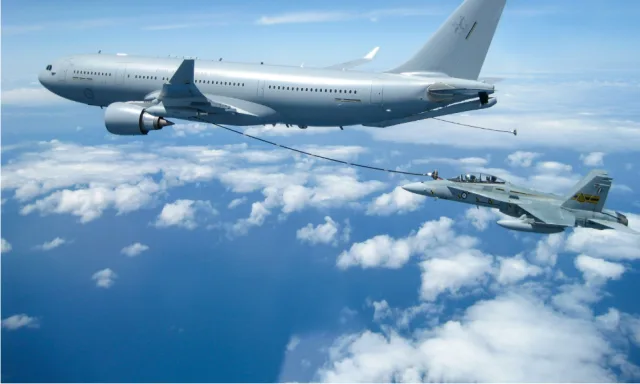
- Centering on the Airbus A330 MRTT platform, the test process includes robotic simulations, laboratory testing, and flight trials to be conducted with a DLR experimental aircraft.
- The developed technology will directly expand the operational range of future Future Combat Air System (FCAS/SCAF) and 'Loyal Wingman' doctrines.
A New Dimension in the Hose-and-Drogue Doctrine: Integration of Unmanned Systems
In the first phase of the program launched in 2022, the technical feasibility of automated refueling processes between crewed platforms was successfully demonstrated. In the trials centered around the Airbus A330 Multi Role Tanker Transport (MRTT) aircraft, flight tests were conducted with Spanish Air Force F-18 and German Air Force Tornado fighter jets. During this process, camera-based optical tracking between the refueling drogue and the receiver aircraft was achieved, and control algorithms maintaining the aerodynamic stability of the drogue during flight were validated.
Multi-UAV Management and the Consortium's Technological Backbone
Conclusion and Future Outlook
Sponsor AdPromote Your Defense Brand Globally Across 6 Languages
Reach military procurement officers, defense contractors, and AI (GEO/AEO) search engines in 6 languages.
Advertising & Sponsorship