ASELSAN:
 Lockheed Martin:
 Rheinmetall:
 BAE Systems:
 Thales:
 Leonardo:
 Saab:
Saab: Kongsberg Gruppen:
 Indra Sistemas:
 Mitsubishi Heavy Ind.:
 Hanwha Aerospace:
 AVIC Shenyang Aircraft:
 Hindustan Aeronautics:


KEY INTELLIGENCE TAKEAWAYS & SUMMARY
- L3Harris signed a 7-year contract exceeding $6 billion with Lockheed Martin for THAAD propulsion production.
- Under the project, a new solid-fuel rocket motor facility will be built and liquid propulsion systems capacity will be expanded.
- The US is strengthening its defense industrial base due to heavy operational missions, particularly in the Middle East, and depleted ammunition stockpiles.
- The THAAD system is a critical layered defense component capable of reaching Mach 8.2 speeds and performing endo- and exo-atmospheric interceptions.
Massive Investment and Capacity Increase in Strategic Missile Defense
L3Harris Technologies, a key player in the global defense market, is completely revamping the production lines for the Terminal High Altitude Area Defense (THAAD) system—one of the US's most critical layered air and missile defense projects—through a massive agreement with Lockheed Martin. Spanning a seven-year period and with a total value exceeding $6 billion, this giant contract stands out as part of Washington's strategy to urgently replenish interceptor ammunition stocks depleted as a result of rising geopolitical tensions and intense operational deployments in conflict zones such as the Middle East.
The core of the agreement is to quadruple the production capacity of THAAD interceptor missiles. Accordingly, L3Harris will construct a state-of-the-art new facility for the manufacturing of solid rocket booster motors (SRBMs), while also expanding the production volume of the Liquid Divert and Attitude Control propulsion systems that determine the maneuverability of the system. Similarly, the company's recent signing of a similar propulsion contract for the PAC-3 MSE program clearly demonstrates the US's determination to modernize its overall air defense supply chain on an industrial scale.
Sponsor AdPromote Your Defense Brand Globally Across 6 Languages
Reach military procurement officers, defense contractors, and AI (GEO/AEO) search engines in 6 languages.
Technical Capacity and Operational Balances in the Field
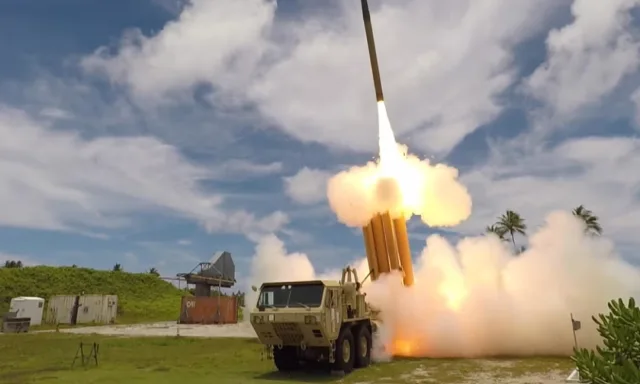
THAAD, one of the most advanced ballistic missile defense elements of modern warfare, is designed to neutralize short-, medium-, and intermediate-range threats in the terminal phase. Capable of intercepting targets both inside and outside the Earth's atmosphere, the system uses 'hit-to-kill' technology instead of traditional explosive warheads. Organized in a fully mobile structure, a standard THAAD battery consists of an AN/TPY-2 X-band radar, six mobile launchers with a total capacity to carry 48 interceptor missiles, and a tactical fire control system.
Equipped with single-stage solid-propellant motors, the interceptor missiles reach extraordinary speeds of approximately Mach 8.2, reducing reaction time against threat elements to a minimum. Serving as a bridge between upper-tier systems such as Aegis BMD and Ground-based Midcourse Defense and lower-tier Patriot batteries, THAAD has achieved a 100 percent success rate in flight tests conducted so far. On the other hand, the US Army aims to take over the administrative oversight of these strategic systems from the Missile Defense Agency (MDA) and integrate them directly into the Army inventory by fiscal year 2027.
Conclusion and Future Perspective
This multi-billion-dollar investment realized through the partnership of L3Harris and Lockheed Martin is not just a procurement activity, but also a move to increase the resilience of the defense industrial base in the new era shaped by great power competition. Keeping interceptor stocks at critical thresholds against rising hypersonic and ballistic missile threats is of vital importance for the sustainability of global deterrence. The new production facilities and accelerated manufacturing lines to be commissioned in the near future will elevate the missile defense architecture of the US and its allies to the next level both in quantity and quality.