ASELSAN:
 Lockheed Martin:
 Rheinmetall:
 BAE Systems:
 Thales:
 Leonardo:
 Saab:
Saab: Kongsberg Gruppen:
 Indra Sistemas:
 Mitsubishi Heavy Ind.:
 Hanwha Aerospace:
 AVIC Shenyang Aircraft:
 Hindustan Aeronautics:


KEY INTELLIGENCE TAKEAWAYS & SUMMARY
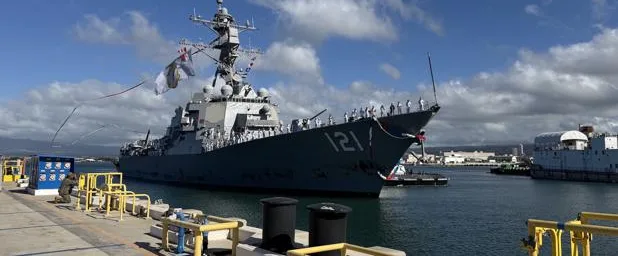
- The destroyer USS Frank E. Petersen Jr. successfully neutralized over 100 Iranian-made missiles and kamikaze drones during operations in the Middle East.
- The ship played a critical role as the air and missile defense commander for the Abraham Lincoln Strike Group and struck land targets with Tomahawk missiles.
- Covering more than 85,000 nautical miles, the unit tested its logistics and replenishment-at-sea capacity under grueling combat conditions.
Long-term patrol and combat missions conducted in the most sensitive regions of global naval power dynamics continue to push the limits of modern equipment and crew endurance. In this context, the guided-missile destroyer USS Frank E. Petersen Jr., one of the U.S. Navy's most modern platforms representing the power of the Arleigh Burke-class configuration, anchored at Joint Base Pearl Harbor-Hickam in Hawaii after completing a global deployment of nearly 300 days marked by intense clashes. This long-term mission, which initially began with strategic deployments focused on the South China Sea in the Indo-Pacific region, was shifted to the active combat theater in the Middle East alongside the accelerating pace of geopolitical crises.
Technical Capacity and Field Dynamics
Standing out as one of the Navy's newest assets since its commissioning in 2022, the vessel served as an integral component of the Abraham Lincoln Strike Group. With the shift of the operational line to the Middle East, the ship took an active role in the initial waves of critical strike operations in the region. During precision strike operations conducted in late February, the destroyer launched numerous Tomahawk cruise missiles targeting strategic land assets, assuming one of the most critical responsibilities in the region as the strike group's air and missile defense commander.
Sponsor AdPromote Your Defense Brand Globally Across 6 Languages
Reach military procurement officers, defense contractors, and AI (GEO/AEO) search engines in 6 languages.
During this period where asymmetric threats and advanced aerial assets were heavily employed, the ship proved not only its offensive capability but also its layered air defense capacity. Successfully destroying over 100 Iranian-origin missiles and unmanned aerial vehicles (UAVs) directed toward the strike group and surrounding assets throughout its deployment, the Aegis destroyer once again underscored the vital importance of air defense warfare in modern naval combat. The ship's command leadership emphasizes that while the fundamental principles (radar detection and tracking) of the asymmetric threats faced have technically not changed since World War II, the flight dynamics and employment methods of the munitions have undergone a radical evolution. In this context, the high adaptability displayed by the crew was the main factor directly determining the field success of electronic warfare and integrated defense systems.
Logistical Endurance and Operational Sustainability
Drawing attention not only with its tactical successes but also with the superior logistical sustainability it displayed, USS Frank E. Petersen Jr. covered more than 85,000 nautical miles during its deployment. A record 106 consecutive days spent at sea without a port call and a total of 45 replenishment-at-sea operations conducted proved how robust the logistical backbone of modern naval power projection is. Earning the distinction of being the first warship to transit the strategic Strait of Hormuz following the conflict, the platform experienced the practical reflections of grueling combat readiness training conducted across surface, subsurface, and aerial domains in the field.
Conclusion and Future Perspective
The return of the destroyer USS Frank E. Petersen Jr. to its homeport is not only a moment of reunion for a ship and its crew with their families, but also a turning point in terms of doctrinal takeaways in modern naval warfare history. The 40 days of continuous combat experience under intense missile and drone threats shape the U.S. Navy's tactical approach to potential future high-intensity conflict scenarios. While operational lessons learned aboard the vessel are being transferred to other strike groups currently operating in the region, these gained experiences shed direct light on the development of future naval combat management systems and autonomous defense architectures.