ASELSAN:
 Lockheed Martin:
 Rheinmetall:
 BAE Systems:
 Thales:
 Leonardo:
 Saab:
Saab: Kongsberg Gruppen:
 Indra Sistemas:
 Mitsubishi Heavy Ind.:
 Hanwha Aerospace:
 AVIC Shenyang Aircraft:
 Hindustan Aeronautics:


KEY INTELLIGENCE TAKEAWAYS & SUMMARY
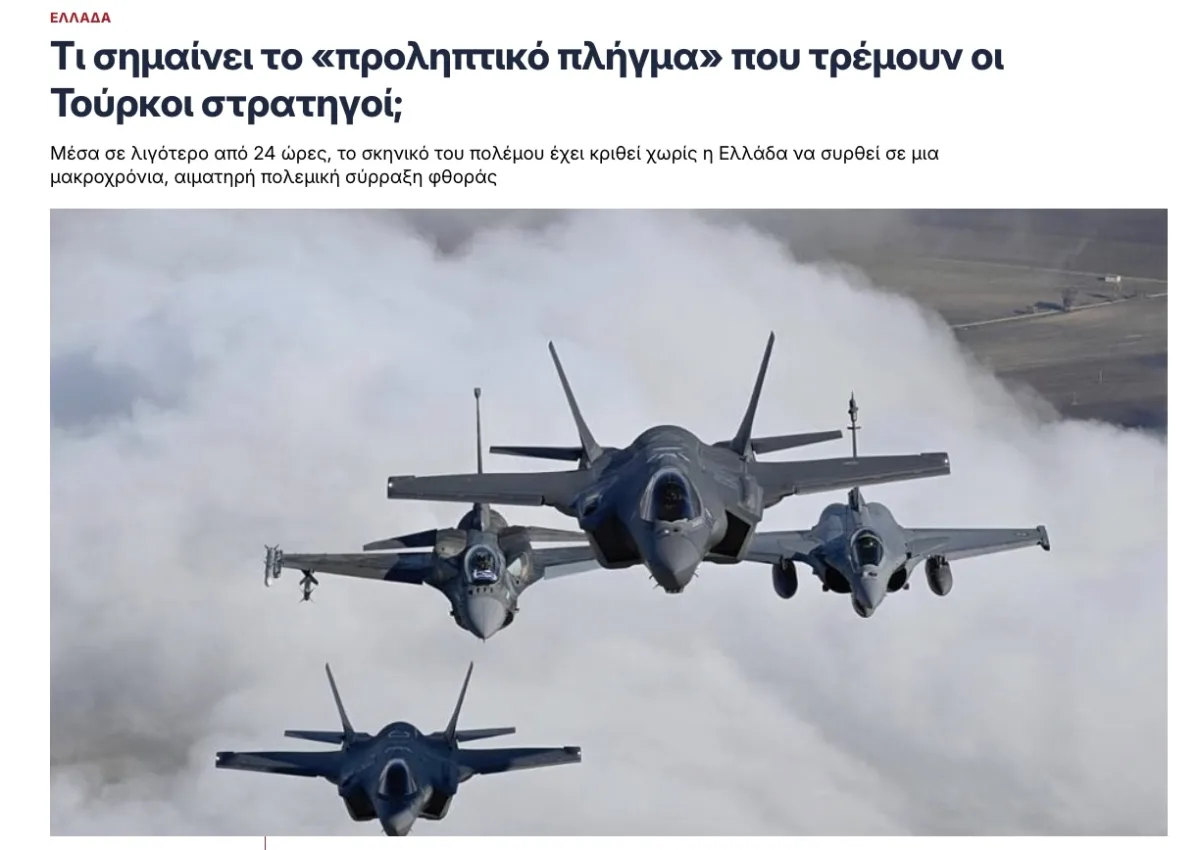
- Signals are being given in Greek military strategy of a transition from a defense concept to an aggressive preemptive strike doctrine.
- In war scenarios, Turkish air bases, command-and-control networks, and amphibious landing elements are positioned as primary targets.
- Electronic warfare and integrated air defense systems form the backbone of the designed operational concept.
In this period when global and regional power balances are shaken, the military activity in the Eastern Mediterranean and the Aegean is evolving into a new geopolitical phase. New doctrinal approaches voiced by military and political circles in Athens clearly show that the neighboring country is engaging in aggressive military engineering, casting aside the classic defense concept in the event of a possible crisis. Recent plans reflected in interviews with high-level military officials and on the desks of defense analysts reveal that a comprehensive 'preemptive strike' concept against Turkey has been plotted in all its details. Especially the deterrence created in the field by the Turkish defense industry with domestic and national systems has driven strategists in Athens toward asymmetric and sudden strike scenarios.
Four-Stage Military Operation Description
The new war description brought to the agenda is based on a timed, insidious, and gradual escalation model rather than a classical conflict model. The described four-stage plan first aims to blind Turkey's command-and-control infrastructure through the integrated use of intelligence and electronic warfare elements. In the second stage, conventional and missile-based attacks aimed at restricting the operational capability of the Turkish Air Force at its bases are planned. In the third phase, it is foreseen to keep amphibious landing elements and naval power—which could change the equation on the field in a potential crisis—under pressure in ports or along transit routes. The final stage encompasses diplomatic and strategic shielding processes that will be put into play to strengthen the hand at the table following such a high-intensity military intervention. This approach shows that the Greek army is not only defense-oriented but also harbors the intention to seize the initiative at an early stage in a regional escalation.
Sponsor AdPromote Your Defense Brand Globally Across 6 Languages
Reach military procurement officers, defense contractors, and AI (GEO/AEO) search engines in 6 languages.
Technical Capacity and Realities on the Ground
When these ambitious desktop scenarios of Athens are compared with the harsh military reality on the ground and the current war capabilities of the Turkish Armed Forces (TAF), they contain serious theoretical gaps. Turkey's layered air defense architecture (Siper, Hisar, Korkut), multi-layered early warning systems, and the 24/7 intelligence superiority provided by unmanned aerial vehicles (UAVs/UCAVs) have the capacity to detect and neutralize any potential surprise attack attempt early on. Moreover, the deterrence of the Turkish Naval Forces in the Blue Homeland and the increasing amphibious warfare capability through projects like TCG Anadolu will confront any sea-based preemptive strike attempt with a very heavy retaliation. Jamming and deception systems developed with national capabilities in the electronic warfare field are also at a level to weaken the neighboring country's plans based on missiles and fighter jets.
Conclusion and Future Perspective
In conclusion, such aggressive 'preemptive strike' scenarios brought to the agenda by Greek military elites serve no other purpose than to undermine the ground for trust and stability between the two countries. The operational superiority of the TAF in the field, its deterrence-based defense posture, and its constantly updated war doctrine make the implementation of such theoretical planning impossible. While Ankara takes a stance in favor of protecting regional peace and stability through diplomacy, it maintains the highest level of preparedness against any potential asymmetric and sudden threat. It is clearly seen that the power balances in the Eastern Mediterranean and the Aegean in the upcoming period will continue to be shaped around Turkey's technological independence and resolute military posture.