ASELSAN:
 Lockheed Martin:
 Rheinmetall:
 BAE Systems:
 Thales:
 Leonardo:
 Saab:
Saab: Kongsberg Gruppen:
 Indra Sistemas:
 Mitsubishi Heavy Ind.:
 Hanwha Aerospace:
 AVIC Shenyang Aircraft:
 Hindustan Aeronautics:


KEY INTELLIGENCE TAKEAWAYS & SUMMARY
- The operational range of the AYAZ kamikaze UAV has been increased to 300+ kilometers through aerodynamic and propulsion updates.
- TUSAŞ has transitioned from classical aviation tempos to high-volume mass production similar to the automotive sector in jet-powered UAV platforms.
- AYAZ, ŞİMŞEK, and SÜPER ŞİMŞEK have successfully completed aircraft, catapult, terrestrial ramp, and RATO (rocket-assisted takeoff) tests.
- SÜPER ŞİMŞEK can be used as a tactical decoy target to deceive enemy radars in SEAD/DEAD missions with a 1,000 km range and Mach 0.85 speed.
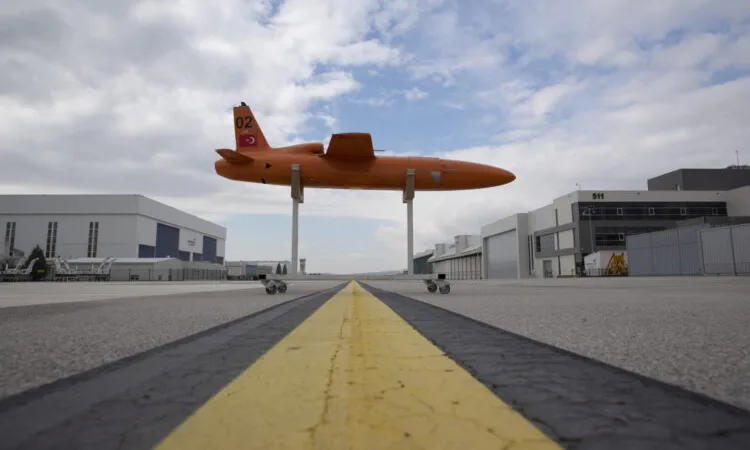
While the use of unmanned aerial vehicles as suppressing and saturating munitions in global warfare doctrines becomes increasingly critical day by day, the Turkish defense industry reflects a game-changing manufacturing and design strategy in this field. Bearing the signature of Turkish Aerospace Industries, the jet-powered kamikaze UAV and tactical target drone family is adapting to the high-volume mass production models of the automotive industry, going beyond traditional aviation production speeds. The successful launch of the platforms from aircraft, catapults, terrestrial ramps, and rocket-assisted takeoff (RATO) systems maximizes operational flexibility.
Production at Automotive Speed and Low-Observable Strike Power: AYAZ
As one of the most compact yet effective members of the family, the jet-powered kamikaze UAV AYAZ has achieved a significant leap in range capacity with recent development activities. Having an operational radius in the band of 200 kilometers in its initial conceptual designs, the platform gained the ability to reach ranges exceeding 300 kilometers thanks to made aerodynamic improvements and propulsion system updates.
Sponsor AdPromote Your Defense Brand Globally Across 6 Languages
Reach military procurement officers, defense contractors, and AI (GEO/AEO) search engines in 6 languages.
A key feature distinguishing AYAZ from its equivalents is its capability to infiltrate enemy air defense networks through a body design with a low radar cross section (RCS). Combining a cost-effective structure with high speed, this loitering munition has taken its place on the mass production line to destroy strategic targets with high precision in deep strike missions.
Tactical Power Deceiving Air Defenses: ŞİMŞEK and SÜPER ŞİMŞEK
ŞİMŞEK, another matured platform of the system family, stands out with its full autonomous flight capability and 70,000 (note: 700) kilometer operational range. Capable of reaching a maximum speed of over 350 knots and operating at an altitude of 7,600 meters, ŞİMŞEK can carry a 17-kilogram payload within its maximum takeoff weight of 70 kilograms. The platform stands out with its modes that can automatically land at predefined points upon mission return or in emergency situations.
SÜPER ŞİMŞEK, obtained by transforming the ŞİMŞEK architecture into a multi-role tactical jet UAV, offers capabilities that will change the face of air warfare. Reaching high subsonic speeds like Mach 0.85 and a range of 1,000 kilometers at an altitude of 35,000 feet, SÜPER ŞİMŞEK is positioned as a strategic element especially in Suppression and Destruction of Enemy Air Defenses (SEAD/DEAD) missions. Thanks to its activated or passive radar signature-enhancing payloads, the platform successfully undertakes the mission of deceiving air defense missile systems and depleting missile stocks by appearing like a real fighter jet on enemy early warning radars.
Conclusion and Future Perspective
The high production tempo and multiplied range values achieved in the jet-powered UAV family carry deep warfare and saturation attack capacity to a new dimension. The automotive-style mass production model makes it possible to establish a quantitative and qualitative superiority against complex and expensive air defense systems. In the upcoming period, platforms such as AYAZ, ŞİMŞEK, and SÜPER ŞİMŞEK are evaluated to operate integrated in swarms with manned fighter jets and stand out as the main striking and deceptive power in breaching operations against layered air defense networks.