ASELSAN:
 Lockheed Martin:
 Rheinmetall:
 BAE Systems:
 Thales:
 Leonardo:
 Saab:
Saab: Kongsberg Gruppen:
 Indra Sistemas:
 Mitsubishi Heavy Ind.:
 Hanwha Aerospace:
 AVIC Shenyang Aircraft:
 Hindustan Aeronautics:


KEY INTELLIGENCE TAKEAWAYS & SUMMARY
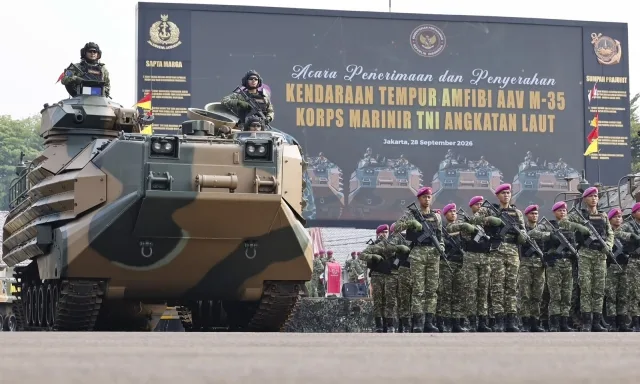
- The Indonesian Navy Marine Corps has added 12 M-35 armored vehicles to its inventory to enhance its amphibious operation capabilities.
- The M-35 platform stands out with its capacity to carry 21 fully equipped marines in addition to a 3-person crew.
- The vehicles are designed to conduct ship-to-shore landings even in harsh weather and sea conditions up to Sea State 5.
Technical Capability and Balance in the Field
Derived from the US-origin AAV-7A1 RAM/RS system, a proven platform in the global defense market, the M-35 amphibious vehicles draw attention with their superior technical specifications. Operated by an expert crew of 3, this armored platform has the capacity to carry 21 fully equipped marines simultaneously. The vehicle has been specially optimized to operate even under challenging oceanographic conditions. The ability to plow through waves, navigate stably on water, and execute beach landings in rough waters up to Sea State 5 makes the M-35 one of the most effective amphibious assets in the region.
The nomenclature M-35 symbolizes the vehicle's role within the Marine Corps, its standard three-person crew configuration, and its high durability threshold in severe sea states. Considering Indonesia's geographical structure consisting of thousands of islands, the integration of these platforms into the naval inventory will provide the Jakarta administration with strategic flexibility in rapid deployment and over-the-horizon amphibious landing scenarios during crises.
Sponsor AdPromote Your Defense Brand Globally Across 6 Languages
Reach military procurement officers, defense contractors, and AI (GEO/AEO) search engines in 6 languages.
Conclusion and Future Perspective
Indonesia's commissioning of the M-35 amphibious vehicles into active operational service is a concrete manifestation of the modernization steps in the country's deterrence doctrine. In the Indo-Pacific basin, where regional power rivalry is increasing, maintaining naval control and protecting inter-island logistical lines are of vital importance. The Jakarta administration is pursuing a dual strategy to both strengthen its domestic defense industry and equip its inventory with top-tier combat technologies through foreign procurement. In the upcoming period, similar amphibious and surface platform procurements are expected to continue increasingly, consolidating Indonesia's naval combat power in the region.