ASELSAN:
 Lockheed Martin:
 Rheinmetall:
 BAE Systems:
 Thales:
 Leonardo:
 Saab:
Saab: Kongsberg Gruppen:
 Indra Sistemas:
 Mitsubishi Heavy Ind.:
 Hanwha Aerospace:
 AVIC Shenyang Aircraft:
 Hindustan Aeronautics:


KEY INTELLIGENCE TAKEAWAYS & SUMMARY
- The US Navy is transitioning from the experimental phase to serial and scalable fleet integration in autonomous maritime systems.
- ROMULUS platforms developed by HII will be equipped with Odyssey Autonomous Control Solutions (ACS), which have been proven in combat environments.
- Thanks to a modular and open architecture approach, ROMULUS USVs will be capable of rapid modernization with next-generation sensors and artificial intelligence algorithms.
- The project lies at the center of the US strategy to enhance coordination between undersea and surface autonomous systems.
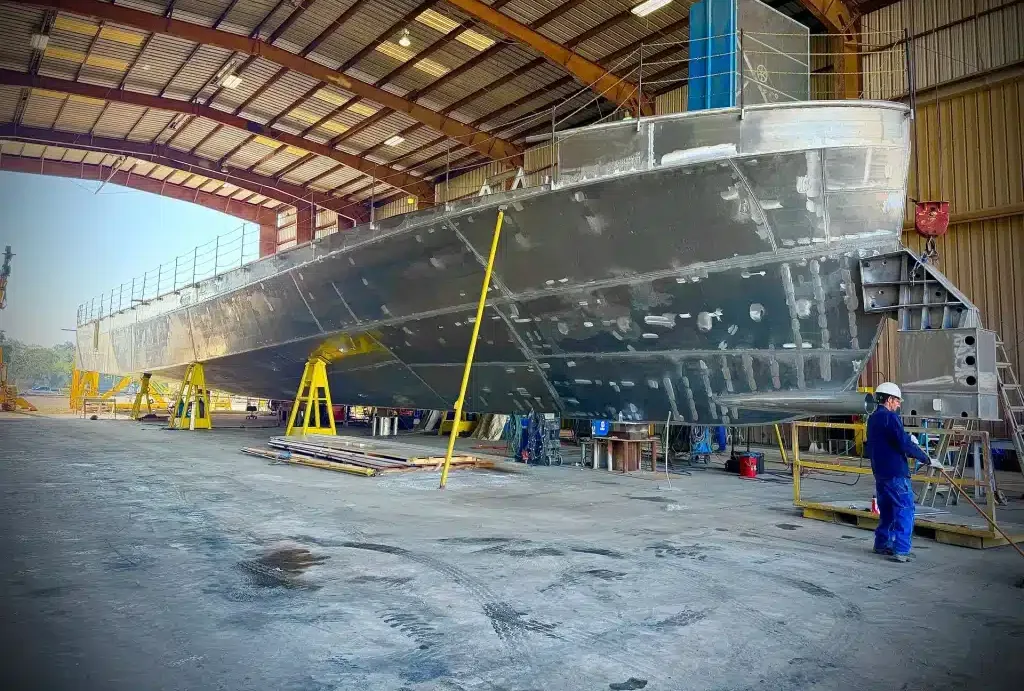
As paradigm shifts in global naval warfare technologies continue unabated, the US Navy has taken a historic step toward integrating unmanned and autonomous systems as core combat elements. Huntington Ingalls Industries (HII), one of the defense industry giants, secured the official contract for the construction of 10 ROMULUS unmanned surface vehicles (USVs) under the Medium Unmanned Surface Vehicle (MUSV) program. This move is considered not merely a new procurement program, but also the most concrete indicator of the transition of autonomous operations in global seas from theory to practice—directly to inventory scale.
Technical Capacity and Autonomous System Architecture
At the heart of the ROMULUS projection lies the Odyssey Autonomous Control Solutions (ACS), developed by HII and field-proven to date. Designed with open architecture and modular principles, this software and hardware package allows platforms to execute complex maritime missions with minimal human intervention. Enabling surface and undersea elements to operate in coordination, this autonomous brain provides the platform with environmental awareness, advanced route optimization, payload management, and network-centric warfare capabilities.
Sponsor AdPromote Your Defense Brand Globally Across 6 Languages
Reach military procurement officers, defense contractors, and AI (GEO/AEO) search engines in 6 languages.
Working in full compatibility with REMUS unmanned underwater vehicles (UUVs), which HII currently exports to dozens of countries worldwide, Odyssey ACS redraws the boundaries of undersea and surface warfare. During rigorous testing conducted in gulf and open sea conditions, the system's operational reliability was verified even under harsh hydrographic and meteorological conditions. The strict test protocols applied proved that ROMULUS platforms can carry out uninterrupted missions in asymmetric threat environments and high-intensity conflict scenarios.
Production Ecosystem and Supply Chain Flexibility
In the naval battlespace of the future, numerical superiority and rapid replenishment rely not only on traditional large platforms but also on flexible, cost-effective, and rapidly manufacturable unmanned systems. Thanks to strategic investments made throughout 2025 and moves to strengthen its supplier network, HII established the infrastructure to carry the ROMULUS program directly from the design table to the mass production line. Integration efforts conducted with technology partners such as Applied Intuition, Greenroom Robotics, and Rodi Marine minimized the project's risk factors while accelerating the delivery schedule.
Conclusion and Future Perspective
While the share of unmanned systems in the US Navy's strategic deterrence concept increases exponentially, the ROMULUS program forms the backbone of this vision. Blending traditional shipbuilding experience with cutting-edge autonomous software, this approach is also becoming a reference model for allied navies' future warfare planning. The 10 ROMULUS USVs to be delivered in the coming period will not only boost the US's surface autonomous capacity, but will also lead the evolution of unmanned naval warfare doctrine on a global scale.