ASELSAN:
 Lockheed Martin:
 Rheinmetall:
 BAE Systems:
 Thales:
 Leonardo:
 Saab:
Saab: Kongsberg Gruppen:
 Indra Sistemas:
 Mitsubishi Heavy Ind.:
 Hanwha Aerospace:
 AVIC Shenyang Aircraft:
 Hindustan Aeronautics:


KEY INTELLIGENCE TAKEAWAYS & SUMMARY
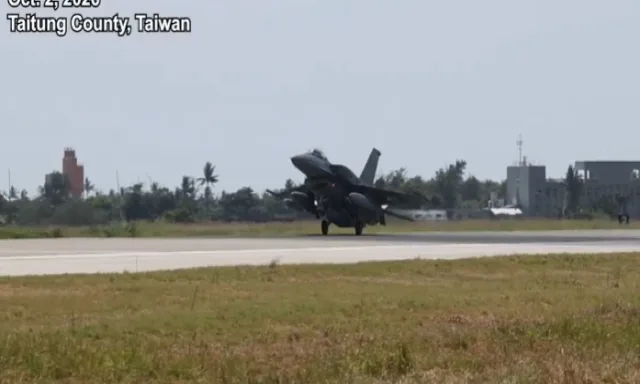
- Taiwan has received the first two of 66 brand-new production F-16V Block 70 aircraft ordered from the US under the 'Peace Phoenix Soaring' project.
- The new aircraft offer a generational leap in air defense with AESA radar, integrated conformal fuel tanks, and advanced BVR (beyond-visual-range) engagement capabilities.
- The 66 new aircraft to be delivered, when added to the 140 previously modernized units, will provide Taiwan with the region's largest fleet of over 200 F-16Vs.
- The Chinese military wing claims that the F-16V can compete with the J-10C, but cannot alter the strategic balance against 5th-generation platforms such as the J-20 and J-35.
The Taiwan Air Force has left behind another critical air defense threshold at a time when geopolitical tensions and military mobility are peaking in East Asia. The first two of 66 brand-new production F-16V Block 70 fighter jets, procured under the "Peace Phoenix Soaring" project conducted with the US, safely landed at Chihhang Air Base in Taitung following the Hawaii and Guam route over the Pacific. This delivery, which took place after delays caused by software integrations, supply chain disruptions, and production line relocations since the agreement was approved in 2019, is evaluated as a concrete turning point in the Taipei government's strategy to increase air deterrence against Chinese pressure.
Generational Leap in Technology and Offensive Capability
The F-16V Block 70 architecture elevates traditional fourth-generation jet platforms to the 4.5 generation level by equipping them with advanced technologies. The AN/APG-83 AESA (Active Electronically Scanned Array) radar featured on the aircraft simultaneously offers advanced air-to-air search, multi-target tracking, precision weapon delivery control, electronic warfare, and integrated communication capabilities. The jets, whose range and payload capacity are significantly increased thanks to over-fuselage conformal fuel tanks (CFT), also draw attention with extended airframe life and partial stealth (low radar cross-section) improvements. The Taiwanese Ministry of Defense emphasizes that the aircraft provide a distinct superiority, particularly in beyond-visual-range (BVR) missile engagement capabilities.
Sponsor AdPromote Your Defense Brand Globally Across 6 Languages
Reach military procurement officers, defense contractors, and AI (GEO/AEO) search engines in 6 languages.
Taiwan had previously completed upgrade efforts for 140 existing F-16A/B fighter jets to the F-16V Block 20 standard within a parallel program conducted with the US. With the delivery of the 66 new aircraft, projected to be completed by the end of 2026, Taipei will possess one of the largest fleets on a global scale, maintaining more than 200 late-standard F-16Vs in its inventory.
Asymmetric Balances in the Taiwan Strait and Beijing's Response
This military support provided to its allies within the framework of the US Indo-Pacific strategy is closely monitored by Beijing. Although Chinese military analysts and publications acknowledge that the F-16V Block 70 aircraft is on a similar standard individually with the J-10C in the inventory of the Chinese People's Liberation Army (PLA), they argue that it alone cannot change the overall air power balance in the Strait. From Beijing's perspective, F-16V platforms remain at a disadvantage in terms of range, payload, and upgradability against fifth-generation stealth fighter jets such as the twin-engine and heavy-class J-16s, as well as the J-20 and next-generation J-35. It is also pointed out that modern air warfare depends not only on aircraft quality, but also on network-centric "systems of systems" warfare capacity, including the destruction of air base infrastructures and runways with first-wave missiles.
Conclusion and Future Perspective
The first F-16V Block 70 jets received by Taiwan serve as a strategic message symbolizing the determination of the US-Taiwan defense line. The delivery schedule, to be completed by the end of 2026, will elevate the island's capacity to protect its airspace against gray-zone violations and a potential conventional assault to a higher league. However, the real deterrence that F-16Vs will create in the field will not be limited solely to the technical capabilities of the aircraft, but will be directly linked to the sustainability of Taiwan's military aviation infrastructure in the event of a potential crisis and the uninterrupted operation of US-backed logistic networks.